



In August 2026, Dhrumil Shah and Michelle Hsu hosted another workshop on AI for Designers. This session was a 30-minute hackathon where small teams used AI to build a feature for a design portfolio.
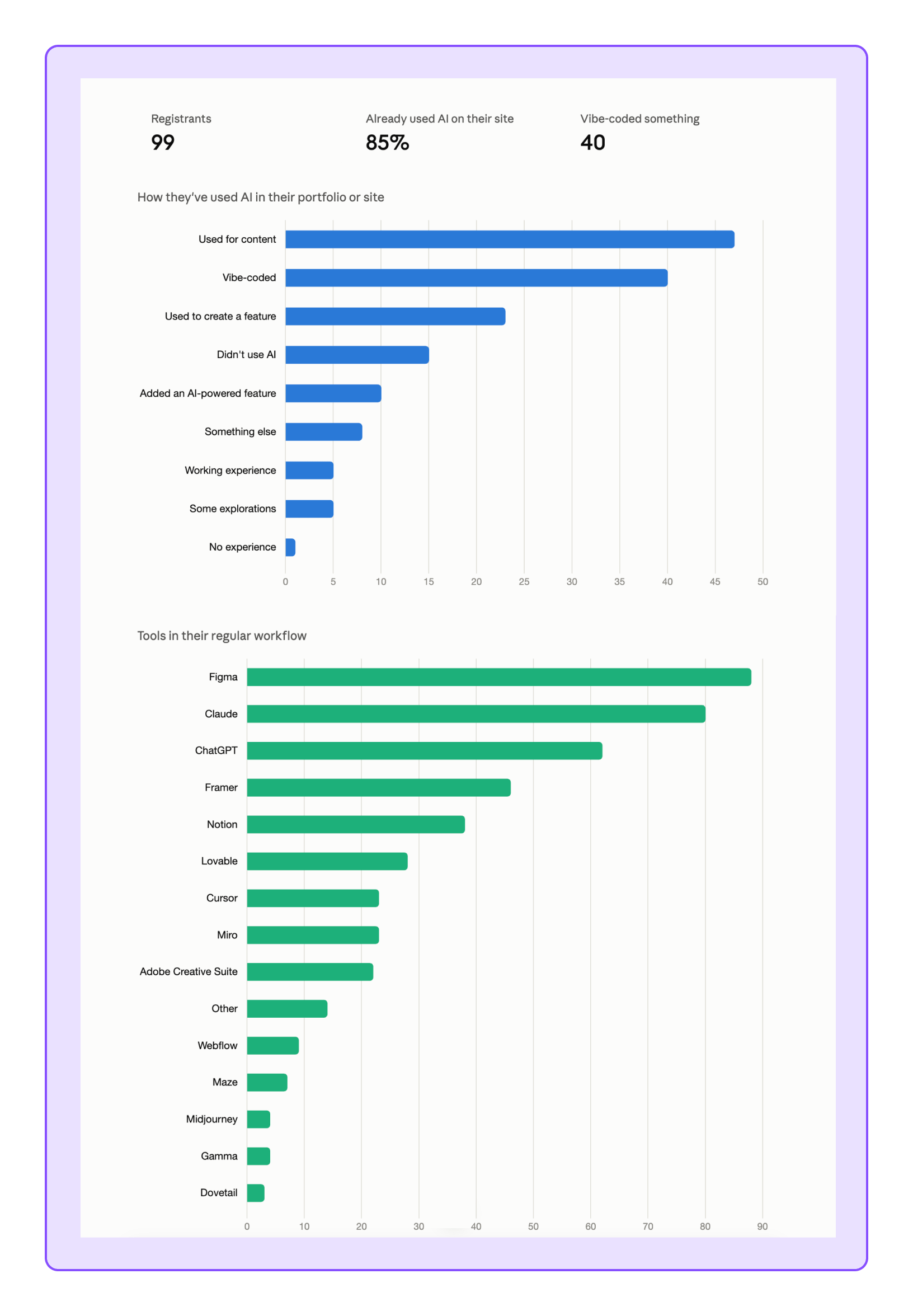
A total of 99 people registered for the event → 41 attended → 18 participated in six teams to build solutions for a design portfolio.
This article summarizes the observation.
“Who are we really designing [the portfolio] for?”
The registration form asked participants what they wished the hosts would answer. Most inquiries weren’t about AI; instead, they revolved around understanding the audience.
“How to make a good portfolio when recruiters only scan for 10 seconds.”
"What is the best way to grab a reviewer's attention when they review your site?"
The image of a user—rushed, skimming, deciding fast—was present among the group days or weeks before the workshop.
The room also shared experiences of building with AI. About half of the registrants—49 out of 99, including those who reported vibe-coding, creating a feature, or adding an AI-powered feature in their portfolios—had already used AI to build something on their site. Among the 41 who attended, 22 had prior experience building with AI.
What they built
Dhrumil’s prompt was to “build a feature in your portfolio to solve a problem and showcase your strength as a designer.”
When asked to showcase themselves, the participants built for the audience. In thirty minutes, six teams created:
Team 1: An assistant that asks visitors who they are and routes them to what they came for (prototype) | 7 votes
Team 2: A voice icon so a recruiter can ask a case study question instead of reading it
Team 3: A matrix mapping how to accommodate different audience types. The recruiter, the hiring manager, and the fellow designer are different readers with different needs.
Team 4: A portfolio re-skinned to the industry the designer wants to enter (prototype) | 11 votes
Team 5: An animated intro line that responds when you hover over it (prototype)
Team 6: A tool where a recruiter pastes a job description and instantly sees how well the portfolio matches the role | 12 votes
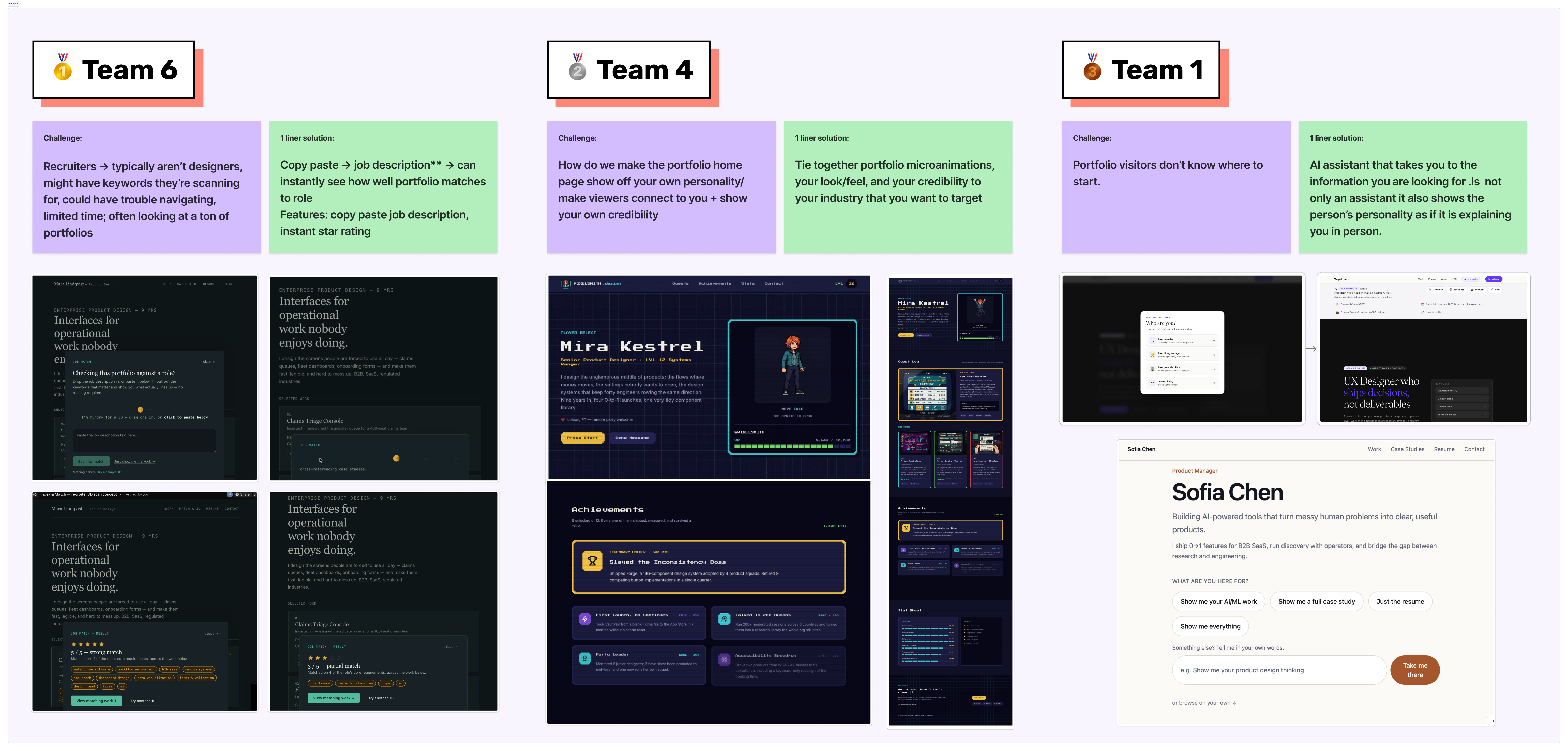
One participant wrote in the reflection: “Feel like we all have same ideas but different approach.” Four of the six builds shortened the reader’s path or filtered information down to what that reader came for. The other two made the designer’s personality faster to grasp. But all six teams framed their challenge around the viewer; even the most self-expressive build started from “designer introduction statement feel too generic to the users.” Not one team’s answer to “showcase yourself” was to say more about themselves.
Each person had three votes after the presentation. The two most-voted builds were the ones that adapted most completely to the reader.
Reading the behaviors
“Showcase your strength as a designer” became “demonstrate how you treat a user.” Their idea of personal branding wasn’t about more narrative or additional content about who they are. It was about showing how they contextualize and accommodate their audience through interactions.
The personal brand became the focal point. For instance, a portfolio that recognizes you’re a recruiter and clears distractions out of your way makes an argument about its owner: this designer studies their users and designs for them.
Although no one explicitly stated this in the room, the behavior was prominent.
In this session, portfolios looked less like stories you read start to finish and more like interfaces you query. You paste a job description and receive a matching response. You say who you are and get a tailored pathway.
What AI was for—and wasn’t
Every tool was allowed during the hackathon. Teams used Claude, Lovable, Figma Make, Stitch, and Magic Patterns, but no team used AI to write their portfolio. They did not generate case studies or about pages. AI was used to build the mechanism without touching the content.
At least one attendee had expected something different. On the reflection board, they noted, “Not exactly what I was expecting... thought there was going to be a lot more demonstration of modern methods of generating portfolio material via AI.” This expectation matches most public conversation about AI and portfolios. Nearly 50% of registrants also reported using AI for content in their portfolios, making it the most common way to incorporate AI, according to the RSVP survey.
Interestingly, that wasn’t what this room did with an open toolbox and a ticking clock. Keep in mind that this was one session, and the format itself favors features, since an interaction demos well in thirty minutes and rewritten case-study text doesn’t.
The unresolved risks
The registration form also asked: “What is your opinion about making portfolio sites using AI - are they losing their personal touch?” Another registrant wanted to know how “to give a portfolio life and make sure it isn’t a ‘museum’ of your work.”
Designers want to be efficient for the person scanning, while staying recognizably themselves. The builds served the first objective, but nobody in the workshop explicitly addressed or solved for personal branding.
There’s also a trust question that we didn’t get to during the workshop. A match score on your own site is a candidate grading their own fit. Does it build trust or spend it?
A third thread came from one of the top-voted teams, whose portfolio was tailored to a target industry: gaming. One member pointed out a challenge. “Threading the line of being able to show you can break out into different industries via your portfolio, but not necessarily having experience in those industries.” The room voted this solution as their favorite, yet the builder expressed uncertainty about where that line sits.
My personal takeaway
Before the breakout rooms, both hosts — Dhrumil and Michelle — demoed AI-powered interactions on their own portfolios. This likely pushed the participants toward interactive elements over content.
Given that the build time was only thirty minutes, it favored showcasing features, as interactive demos are more engaging than rewritten case study text.
This article is a close look at what one room revealed under pressure, not a comprehensive study of how designers everywhere build portfolios today.
However, now that designers have access to tools that translate their exact vision into code or features, it unleashes the potential for what designers can create on their personal websites.
I believe that the concept of a great design portfolio will soon evolve. The site itself will need to embody and showcase various aspects of interaction, usability, accessibility, animation, and more complex content strategies. It will no longer suffice to describe how designers applied their skills and expertise in past projects. Designers will express their identities and personal brands through the website as a product, rather than just a few words and visuals.
The importance of content and case studies still stands strong. A routed portfolio full of weak case studies is just a faster way to a “no”. Clearly communicating designers’ ideas, impact, intentions, vision, and strengths is a critical skill.
Share this and your portfolio
If this has inspired you to reflect on your own site, it may do the same for other designers and design leaders around you, so feel free to share it.
Also, please share your favorite designers’ portfolios in the comments.
How are those designers showcasing their personal brands through their website? What do they demonstrate that a paragraph alone could never convey?
Workshop 6, Build your Design: From Idea to Product, is now open. RSVP today: https://luma.com/w1euddfo
This research comes from Workshop 5 of the AI for Designers series at Designed Minds, a community of design-builders who think like designers and build like entrepreneurs. Join us at designedminds.co.